
The NileView
AACSB Journey in Business Education: From National Accreditation to Global Standards

Business education has spent more than a century defining itself. What began as informal apprenticeships and commercial training has evolved into a global enterprise of research, teaching, and societal engagement, shaping economies and preparing leaders across every continent. At the center of that journey stands the Association to Advance Collegiate Schools of Business (AACSB International) – whose 110-year legacy, in many respects, is the story of business education.
At the outset, the objective was never about accreditation but about defining business education. However, a century later, the story has taken many forms, and in July 2026, AACSB enters an exciting chapter in its journey with the introduction of the Global Standards for Business Education™, a framework that sets out principles and criteria for what it means to offer quality, impactful business education that meets evolving societal needs and accommodates global transformations and disruptions.
The Roots of Business Education
Founded in 1819, ESCP Business School in Paris is widely regarded as the world’s first business school. By the late 19th century, business education had spread widely and entered the university setting, culminating in the founding of The Wharton School in Pennsylvania in 1881, which is recognized as the first collegiate business school in the United States.
As industrial expansion fueled demand for professionally trained managers, business schools proliferated across the United States. Yet academic rigor varied widely, prompting important questions about whether business education should be part of the academy at all. Many programs resembled commercial or vocational training institutions. There were no shared standards for curriculum, faculty qualifications, degree requirements, or learning expectations.
From a Room of 17 Deans to a Global Movement
On Saturday, 17 June 1916, 17 American deans gathered in Chicago. Their purpose was not yet accreditation but something more fundamental. They shared a conviction: that business education, still in its infancy within universities, needed a common foundation. The questions they faced were not merely administrative. They were convinced that without agreed-upon standards, business education risked fragmentation, reputational dilution, and marginalization. Furthermore, at stake was whether business education could claim a rightful place alongside law, medicine, and engineering as a recognized intellectual discipline. They understood that collective action was the only credible defense against uneven quality in a rapidly expanding field.
The deans came from Harvard Business School (Harvard University); Booth School of Business (University of Chicago); Columbia Business School (Columbia University); Tuck School of Business (Dartmouth College); Wharton School (University of Pennsylvania); Stern School of Business (New York University); Kellogg School of Management (Northwestern University); Haas School of Business (University of California, Berkeley); Nebraska College of Business (University of Nebraska); Gies College of Business (University of Illinois Urbana-Champaign); Katz Graduate School of Business (University of Pittsburgh); Fisher College of Business (Ohio State University); McCombs School of Business (University of Texas at Austin); Freeman School of Business (Tulane University); Wisconsin School of Business (University of Wisconsin–Madison); Yale School of Management (Yale University); and Johnson Graduate School of Management (Cornell University).
AACSB Established
The meeting led to the creation of the Association of Collegiate Schools of Business (ACSB), which was renamed the American Assembly of Collegiate Schools of Business (AACSB) in 1925. It is a professional body whose initial mission was clear: to establish a unified definition of what a collegiate school of business should be. What followed was a century of purposeful evolution.
That founding instinct – the belief that quality is a collective responsibility, not a private claim – remains the bedrock of accreditation today. It assures students, employers, governments, and society that a business school has been independently evaluated against rigorous, peer-developed standards. More than that, in a world saturated with credentials, accreditation today serves as a signal of trust: a promise that an institution is committed not only to meeting standards but also to continuous improvement.
Gradually, AACSB developed curriculum and faculty standards, introduced peer review, and – through the crucible of the Great Depression – strengthened the case for disciplined management education. By the 1940s, master’s-level business education had gained prominence, and standards began to extend beyond undergraduate programs.
AACSB: A Recognized Accrediting Body
During the post-war era, the scale of higher education was reshaped and further accelerated by the GI Bill; enrollment expanded, new schools and programs were established, and quality variation widened. In 1948, the AACSB membership list functioned as a public signal of credibility.
In 1953, AACSB membership voted to transition from a membership association to an accrediting agency. Recognition by the National Commission on Accreditation followed in the same year. Enforcement mechanisms strengthened as probation, suspension, and clearer reaccreditation cycles were institutionalized, preserving a unified school-level model rather than allowing fragmentation into discipline-specific systems. At the same time, the organization’s administrative capacity grew, laying the groundwork for a more professional infrastructure and solidifying AACSB accreditation as the national benchmark for the quality of business education. It evolved from an episodic collegial review into a formal, recurring quality assurance system. By 1960, accreditation had become AACSB’s central organizing principle.
In late 1959, landmark studies sponsored by the Carnegie Corporation and the Ford Foundation challenged business schools to raise their academic rigor. AACSB responded decisively by embedding faculty qualifications, research expectations, improved curricula, doctoral preparation standards, and analytical depth into its accreditation framework. Peer review processes also became more structured, and standards were clarified. These changes helped transform business education into a research-driven discipline anchored in the university system. This shift firmly embedded business education within the research university model and laid the foundation for its global credibility.
AACSB Goes Global
In 1968, the business school at the University of Alberta in Canada became the first AACSB-accredited school outside the United States. The early 1990s marked the era when globalization was reshaping economies and higher education, and many more schools globally pursued accreditation. The pivotal 1991 adoption of mission-based standards shifted evaluation from uniform structural requirements to alignment with institutional mission – preserving rigor while enabling flexibility across cultures and contexts. This shift was visionary: it acknowledged that excellence is not monolithic. A business school in Cape Town, Santiago, or Mumbai serves different communities, operates within different regulatory environments, and draws on different intellectual traditions than one in New York, London, or Sydney. Quality, the new philosophy declared, is not uniformity – it is rigorous alignment between mission, strategy, and demonstrated outcomes.
In 1997, ESSEC Business School in Cergy-Pontoise became the first accredited school outside North America, signaling the organization’s full transition to global accreditation. That same year, AACSB formally separated membership from accreditation. In 1999, governance reforms transformed it from an American association into a globally oriented accreditation organization, rebranding it the Association to Advance Collegiate Schools of Business (AACSB). In 2003, assurance of learning and continuous improvement were formalized as core elements of accreditation standards, further institutionalizing outcomes-based quality review and decisively shifting accreditation from input-based compliance to outcomes-based quality assurance.
In 2006, Onsi Sawiris School of Business was the first school in Africa to receive accreditation. Ironically, I was part of the core team that worked on the rigorous, multiyear institutional process starting in 2001, which went through several structured phases before we submitted our self-evaluation report on the way to our initial accreditation.
The Age of Engagement, Innovation and Impact
In 2008, the global financial crisis prompted urgent questions about corporate ethics and the role of business in society, as emerging technologies, digital platforms, and data analytics reshaped the delivery of business education. Stakeholders were no longer satisfied with evidence of academic rigor alone – they demanded relevance, measurable impact, and societal contribution.
During the first two decades of the 21st century, AACSB revised its standards in 2013 and 2020. The 2013 framework formally integrated engagement, innovation, and impact into the accreditation DNA, shifting the central question from “Is this school academically sound?” to “Is this school creating meaningful value for business and society?” By 2020, impact was not merely encouraged – it was explicitly defined and evaluated, with schools expected to demonstrate how their intellectual contributions influence practice, policy, and the communities they serve. As a result, accreditation expanded beyond evaluating structures and processes to assessing the value business schools create for learners and the broader communities they serve. Accreditation also began recognizing innovation, new program formats, interdisciplinary approaches, digital delivery models, and emerging fields such as analytics and entrepreneurship.
From Accreditation to Global Standards
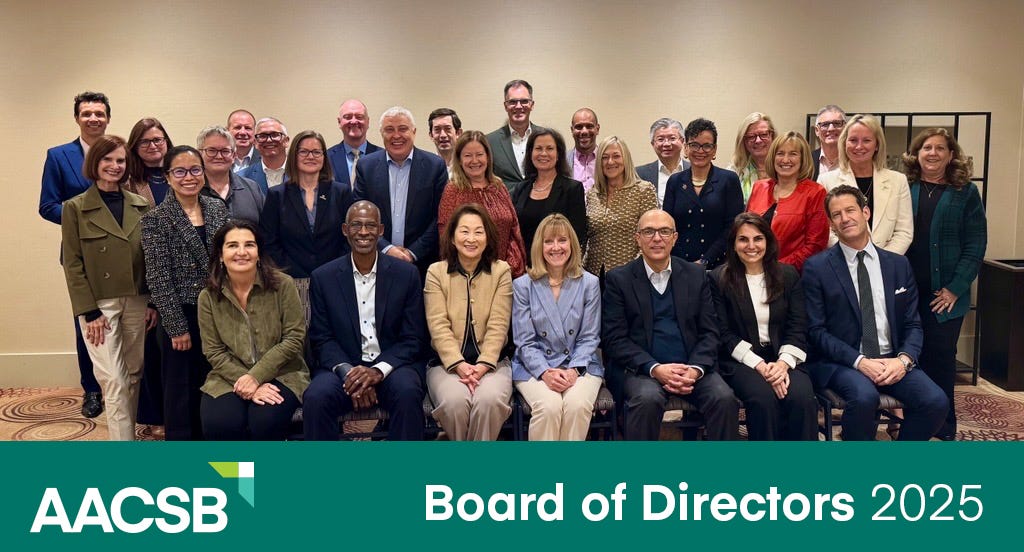
In 2025, I was privileged to chair the board of directors when AACSB launched a comprehensive governance review to align its structure with its global scale and complexity. The resulting model enhances agility, accountability, and strategic responsiveness while better serving its worldwide membership. The reform streamlined board composition, strengthened competency-based and globally representative leadership, and established a Global Standards Committee separate from accreditation oversight, thereby reinforcing independence, transparency, and the integrity of standard-setting and accreditation decisions.
The board made the landmark decision to reposition AACSB’s accreditation standards as the Global Standards for Business Education – serving not only the approximately 6% of institutions that hold accreditation but also the full spectrum of business schools worldwide, reflecting AACSB’s vision, leadership, and commitment to the future of business education.
July 2026: A New Chapter Begins
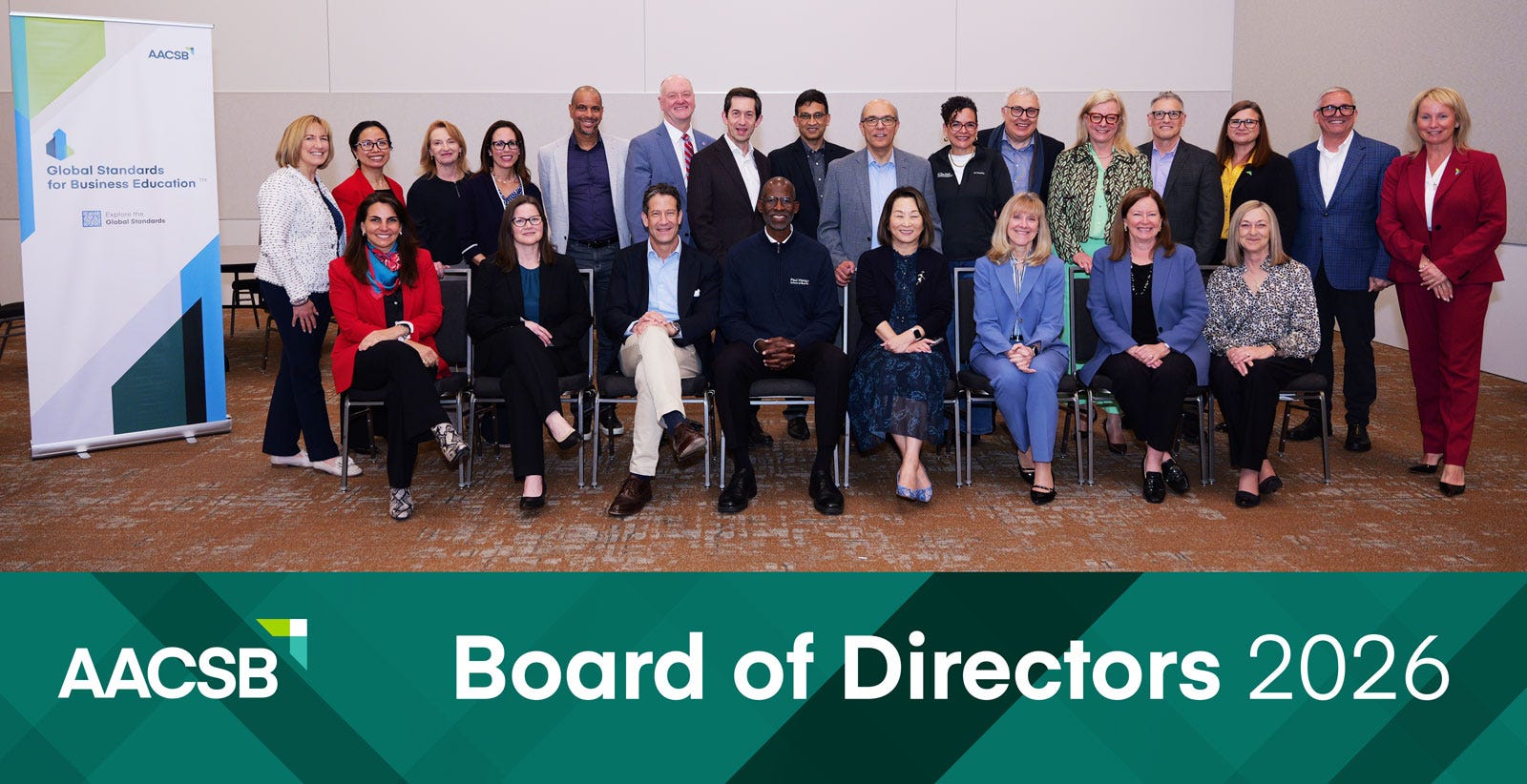
In April 2026, at the International Conference and Annual Meetings (ICAM) in Seattle, following more than a year of conversations with many members of the community, a thorough review and discussion by AACSB’s Standards Taskforce, Accounting Accreditation Policy Committee, and Business Accreditation Policy Committee, and the incredible work of AACSB’s executive team and staff, the Global Standards for Business Education™ were presented and ratified by the membership. The standards formally launched on July 1, 2026, marking the start of what may well prove to be AACSB’s most significant chapter.
Previous AACSB standards were explicitly designed for schools seeking accreditation. The 2026 Global Standards are designed for all business schools. They provide a universally accessible quality framework: a common language for excellence that any institution can use to guide strategic development, strengthen performance, and demonstrate meaningful impact for learners, employers, and society. Accreditation remains the gold standard of external validation – the formal recognition that a school has not only adopted these principles but also demonstrated alignment with them through rigorous peer review. But the Global Standards now serve as a broader public good, a quality compass available to the entire universe of more than 17,000 business schools worldwide.
The new framework preserves the nine core standards that schools have worked with since 2020, organized within three coherent pillars: (a) Strategic Management: Strategic planning, resources, and faculty – the foundation of institutional capacity; (b) Learner Success: Curriculum design, assurance of learning, and learner progression – the heart of educational delivery; and (c) Pathways to Impact: Teaching effectiveness, scholarship impact, and societal engagement – the proof of a school’s value to the world.
The introduction of Pathways to Impact as an explicit organizing principle is particularly meaningful. It acknowledges that there is no single road to excellence. A school embedded in an emerging economy may create its greatest impact through transformative teaching and entrepreneurship education. A research-intensive institution may drive change through scholarship that shapes global policy. A school deeply connected to its community may demonstrate excellence through engagement that drives local economic development. All are valid. All are valued. In addition, teaching effectiveness, long implicit, is now a measurable and explicitly required dimension for all faculty. Societal impact, previously scattered across standards, is now consolidated as a strategic imperative with documented evidence requirements. The shift from “do processes exist?” to “what difference do these processes make?” runs throughout the new framework.
The Local Context: An Opportunity, Not a Constraint
The framework introduces a powerful concept: global standards with local application. Rather than prescribing a uniform model, the standards explicitly call on peer review teams to assess how effectively schools apply the framework within their regional, cultural, regulatory, and institutional contexts. This is not a dilution of rigor – it is a deepening of it. The standards affirm that true quality must be responsive to context. A business school in Africa, Latin America, or Southeast Asia does not need to replicate what top schools in Europe or North America do to achieve excellence. It needs to demonstrate that it is achieving its mission with integrity, rigor, and measurable impact.
For example, in the Middle East and Africa (MEA) region, business schools operate in highly dynamic environments. In this context, the standards present an extraordinary opportunity. Rapid urbanization, a youth demographic dividend, ambitious national transformation agendas, and the rise of entrepreneurial ecosystems are reshaping what business education must deliver. Schools across the region are expanding access, building research capacity, and forging partnerships with industry and government to address regionally distinct yet globally connected challenges – from sustainable development and food security to digital transformation and youth employment.
Adapting to Global Trends, Disruptions and Transformations
The Global Standards are a deliberate response to the most complex pressures AACSB has ever faced – faster, simultaneous, and global. Understanding these forces is essential to appreciating why the new framework matters.
Technological disruption, led by artificial intelligence, is compressing the relevance cycle of business education and challenging traditional models of teaching, research, and assessment. Students and families increasingly view degrees as financial investments amid rising tuition and shorter career cycles, intensifying scrutiny of value propositions and measurable career outcomes. Geopolitical fragmentation and demographic contraction in several regions are straining enrollment and institutional financial resilience. A persistent gap between academic theory and managerial practice continues to call into question the relevance of business school research, while disciplinary silos within schools increasingly misalign with the integrated, cross-functional way modern enterprises operate.
Meanwhile, demand for business literacy is spreading across the entire university – engineering, science, health, and humanities students increasingly need foundational business fluency to translate their expertise into impact. The field of management itself, taught everywhere yet governed nowhere as a coherent profession, faces renewed pressure to articulate clear standards for competence and ethical responsibility.
The Global Standards address this landscape by articulating a shared vision of excellence that supports quality across diverse geographies, cultures, and institutional missions. They define what high-quality business education looks like in a dynamic world that demands innovation, ethical judgment, a global perspective, and meaningful impact.
The Global Standards serve two purposes: to provide a unified framework for all business schools worldwide to advance quality and impact, and to define the evidence and expectations required to achieve and maintain AACSB accreditation. With this step, AACSB expands its role to include global standard setting, in addition to accreditation. However, the power of global standards lies in their ability to be meaningful locally. This is where the new framework holds promise for regions that have historically been on the receiving end of standards set elsewhere.
The mission-based philosophy AACSB adopted in 1991 remains the essential bridge between global aspiration and local relevance. It recognizes that excellence cannot be defined the same way in every context: a school serving a fast-growing entrepreneurial economy, a school embedded in an oil-reforming national economy, and a school in a mature market may each pursue different missions while upholding the same commitment to quality and impact. The Global Standards reinforce this principle by providing a common language for evaluating and benchmarking quality while respecting institutional diversity.
For local institutions, the value is twofold. First, the standards provide a credible, internationally recognized framework for strategic development – whether or not a school pursues formal accreditation. Second, they create a pathway for regional schools to benchmark against and contribute to a global conversation about what constitutes excellent business education, ensuring that the region’s distinctive knowledge, culture, and priorities shape the global standard rather than merely conform to it. This is what local context means within a global framework: not homogenization, but confident participation.
Accreditation, properly understood, is not about compliance. It is about institutional confidence – the discipline of asking hard questions about strategy, outcomes, and societal contribution, and the courage to act on the answers. With the Global Standards for Business Education™ now in effect, AACSB assumes a role that extends beyond ensuring quality at accredited institutions to advancing excellence across all of business education. The standards provide the basis for an integrated system – one that not only recognizes excellence but also inspires advancement across the entire field.
This evolution affirms what the founding deans of 1916 intuitively understood: that the health of business education is a shared responsibility and that quality is sustained not by gatekeeping alone but by a continuous, collective commitment to improvement. The new framework invites every business school – in every geography, of every mission and size – to see itself as part of that shared enterprise.
Looking Forward
The road ahead is demanding, but the direction is promising. The structural pressures of our era – technological, economic, geopolitical, and societal – are real, yet they also clarify what matters most: relevance, impact, integrity, and the ability to prepare learners for a world that will continue to change. Business education has repeatedly reinvented itself, and each reinvention has left the field stronger, more credible, and more useful to society.
The launch of the Global Standards is the latest expression of that tradition of reinvention. I am delighted and honored to chair the Global Standards Committee for the 2026/2027 academic year. It offers business schools worldwide a framework to guide strategic development, demonstrate commitment to quality, and create positive change for learners, business, and society. For institutions in Africa, the Middle East, and across emerging economies, it is an invitation to help define the next century of business education with agency and confidence.
110 years after 17 deans met in Chicago to define what a business school should be, that founding question is being asked again – this time on a global stage, with the whole world invited to answer. The future of business education will not simply happen to us. It is something we should all build together.
AACSB’s over-a-century-long journey is, at its core, a story of willingness and readiness to change…to the next 110 years…
About the authors: Lily Bi, President and CEO, Association to Advance Collegiate Schools of Business, and Sherif Kamel, Professor of Management and Dean of the Onsi Sawiris School of Business at The American University in Cairo.
30 July 2026
Issue #70