
The NileView
A Business-Science Integrated Approach to Learning: The Imperative Partnership

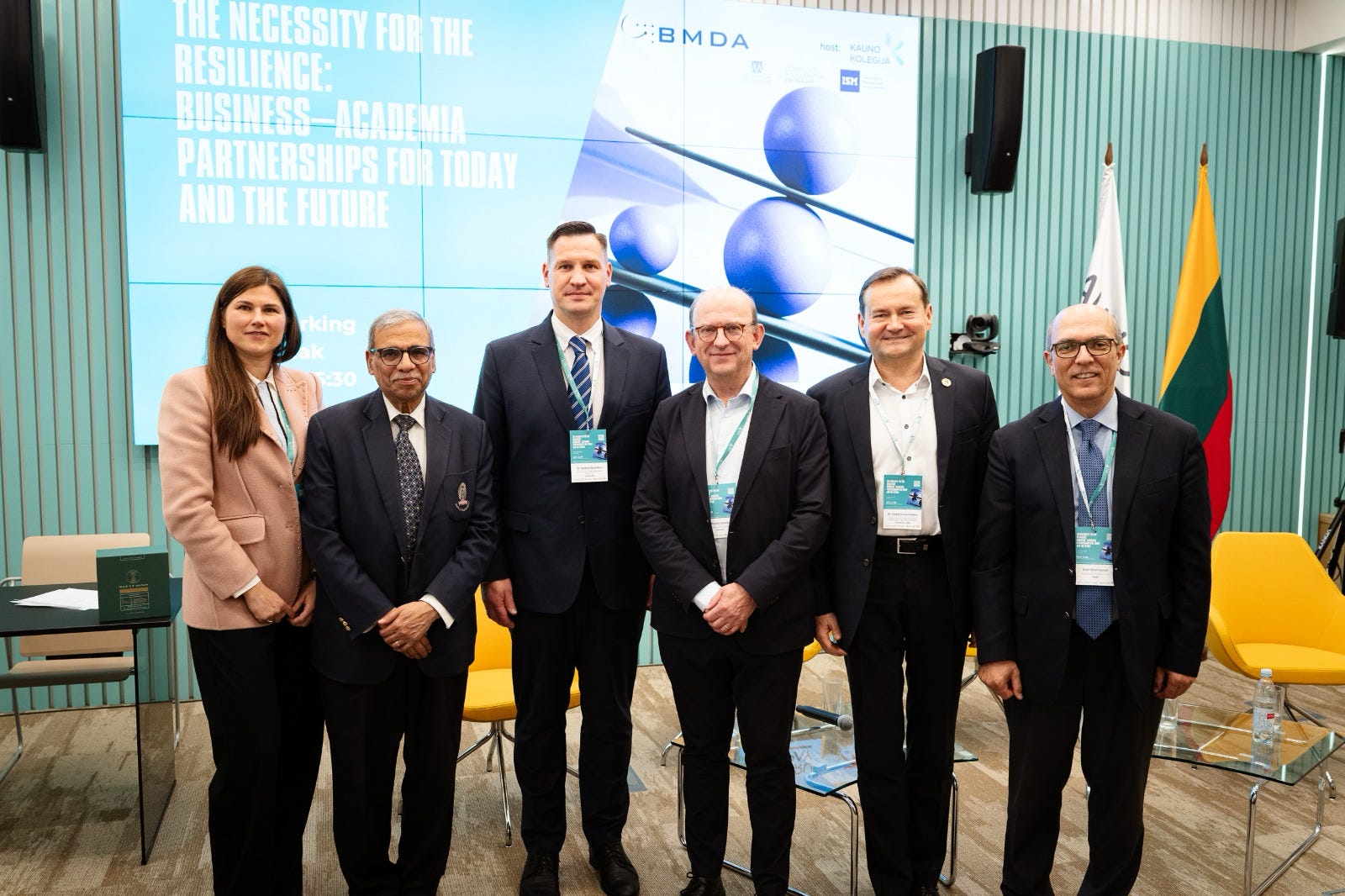
The 24th annual conference of the Baltic Management Development Association (BMDA) was held from 20-22 May in Vilnius, Kaunas, and Alytus, Lithuania, a country at the crossroads of cultures, innovation, and collaboration. The theme was Catalysts of Change: Business–Science Partnerships for Tomorrow.
The theme addressed an issue that has never been more timely, urgent, or relevant. It requires ongoing dialogue among stakeholders to align efforts toward a common purpose and set of objectives. The conference was not merely an academic discussion; it was a platform for exchanging ideas and deepening understanding of both academic and business needs, enabling well-thought-out, coordinated expectations and a call to action that can help better define the preparedness of the next generation of business leaders, as well as what is needed to ensure the competitiveness of our economies and the resilience of our societies. It goes without saying that artificial intelligence and its responsible and ethical use were integral to the conversation.
This conversation, like many others around the world, will help define what business education will look like in the years to come–a question that businesses and business schools continue to examine as they navigate today’s complexities. It will also explore and clarify how the NextGen Business Schools should navigate global uncertainties and complexities, and how they envision their path to preparing future leaders, entrepreneurs, and change agents who can make a difference in society. On this note, business schools have no choice but to cultivate a mindset of lifelong learning, equipping graduates with the skills to adapt to evolving societal needs. They must embed science and technology at the core of their curricula, ensuring that future leaders are fluent not only in management but also in data science, social sciences, innovation, and ethics.
A Convergence of Opportunity and Necessity
The business-science partnership has evolved rapidly over the past few decades. What once existed as occasional, transactional relationships has matured into more strategic ecosystems where knowledge creation, innovation, and practical application form an interconnected continuum. Universities and business schools, in particular, have emerged as laboratories for such collaboration, where agile startups, established enterprises, and research institutions are helping break down traditional silos to address complex challenges and offer innovative solutions to society’s problems. For example, in many places, including Vilnius, which is known for its rich multicultural history, there is growing recognition of its vibrant tech and innovation ecosystem, particularly in digitalization, cybersecurity, logistics, fintech, the Internet of Things, biotechnology, and more.
For the past few decades, we have witnessed unprecedented convergence. Digital transformation—accelerated exponentially, beginning in the early 1980s with the advent of personal computers—has fundamentally altered the relationship between business and science. We should see more of that in the future, all contributing to the value proposition for students and learners while offering alternative solutions for business and industry as societies explore opportunities to develop, grow, and excel.
Artificial intelligence, quantum computing, biotechnology, and sustainable technologies are no longer emerging fields; they are the infrastructure upon which tomorrow’s economy is being built–some would argue it is even today’s game changer, where a race for talent and knowledge will be essential. From biotechnology to artificial intelligence, from sustainable energy to digital finance, the fusion of scientific discovery and business acumen is driving breakthroughs that shape industries, societies, and the very fabric of our daily lives. The question is: How is this reflected in the curriculum? In research? In the experiential learning journey of today’s students and tomorrow’s leaders?
These emerging trends and accelerating advances demand a new paradigm of collaboration, one in which the boundaries between theoretical research and market application blur and scientists understand business imperatives while business leaders embrace scientific rigor. More importantly, it is worth emphasizing that a truly seamless, integrated, interdisciplinary approach to education and lifelong learning is no longer optional, particularly in business education.
Partnership as Social Imperative
The importance of the business-science partnership extends far beyond economic metrics. Our societies face existential challenges: geopolitical shifts, climate change, healthcare access, digital inequality, and the need for sustainable economic growth–all requiring adaptive strategies. These challenges are too complex for any single sector to address alone. Building a responsible ecosystem grounded in strong partnerships is essential, and collaborative approaches are critical to serving and elevating the prospects of our respective societies. They should adopt an inclusive approach that leaves no one behind and drive collaboration between business and science, as well as between business and industry. When businesses harness scientific innovation responsibly, they create solutions that extend beyond profit margins—solutions that empower communities, protect ecosystems, and expand opportunities. These partnerships, alliances, and collaborations will define our future. In this sense, collective, impactful collaborations and partnerships are not just about advancing markets; they are about advancing humanity.
There are many ways in which partnerships between business and science can serve society, including but not limited to:
Accelerating Innovation: Moving breakthrough discoveries from the laboratory to the market, ensuring that research investments deliver tangible societal benefits by integrating technology, research, and innovation, and bridging the divide between academia and business.
Building Inclusive Prosperity: Creating high-value employment, fostering entrepreneurship, and developing future-proof skills that keep our workforce competitive in a global economy. It is all about talent and human capital–people, the most important asset in society.
Addressing Grand Challenges: Mobilizing the complementary strengths of rigorous research and practical implementation to tackle climate, health, and social issues. A call for more experiential learning, community engagement, and out-of-class and off-campus activities and projects that are well integrated into our students’ and learners’ learning journeys.
Strengthening Competitiveness: Focusing on preparing innovation leaders, attracting talent and investment, and retaining our best minds.
When business and science partner effectively, they create a virtuous cycle: research becomes more relevant, business becomes more innovative, and society hopefully gains solutions to its most pressing problems. This is a testament to the fact that silos within business and science, and between them, can no longer deliver the value proposition that markets want.
Transforming Business Education: What’s Next?
This brings us to a series of critical questions that must be thoroughly addressed: What does all this mean for the future of business education? What can we do as educators, business school leaders, and administrators? What can we do together? What do we need to change? Are we ready to take transformative actions to address evolving market dynamics? Where should we start? One thing is for sure: we need to think differently, not just cosmetically but really differently, and be open to revisiting how we think and what we believe in–an opportunity to revisit the value proposition of business education–together as a community of engaged stakeholders.
On this note, business schools stand at an inflection point. The traditional models—built largely around case studies of past business successes, functional silos, and established management frameworks—are insufficient for a world marked by radical uncertainty, technological disruption, and the need for systemic and critical thinking. The model of lecturing for hours will need to be reconfigured. Integrated experiential learning will dominate in many different forms. Teaching will be different, more of a conversation, a debate about real-world issues and societal problems.
The Digital Transformation of Learning
The acceleration of digital transformation is fundamentally reshaping how business schools educate the next generation of leaders. It has democratized access to information, enabled global collaboration, and created new pedagogical possibilities through AI-driven personalized learning, immersive simulations, and real-time industry engagement. However, technology is a tool, not a solution. We should remember that it is merely a means to an end. Other questions we need to address include: How do we harness these capabilities to develop leaders who can navigate complexity? How do we align technological, human, and institutional capabilities to sustain leadership resilience? What ethical frameworks must leaders adopt to balance innovation with responsibility? How can leaders build adaptive structures that thrive amid uncertainty and disruption? What forms of experiential learning best prepare leaders for ambiguity and rapid change? These and other issues need to be continually addressed by business schools in coordination with other stakeholders in society.
NextGen Business Education: A Partnership-Driven Model
The future of business education must be built on business-science partnerships that drive the co-creation of what students are taught and the pedagogical approaches through which they learn. I envision several transformative shifts, including:
Interdisciplinary Integration
NextGen business education must break down disciplinary boundaries. Tomorrow’s leaders need to be conversant in data science, understand the fundamentals of emerging technologies, and grasp the scientific method. At the same time, they must master strategy, organizational behavior, and ethical leadership. This requires deep collaboration and partnerships among business schools, engineering and social science schools, and scientific research centers, as well as working side by side with business and industry.
Living Laboratories
Business schools must become living laboratories where students engage directly in real-world scientific research and business challenges. Imagine undergraduate or graduate business students working alongside molecular biologists to commercialize breakthrough therapies, or doctoral candidates collaborating with manufacturers to implement AI-driven supply-chain innovations. This is not an internship; it is an integrated, multidisciplinary approach to learning that cultivates an innovative, entrepreneurial mindset.
Research-Practice Integration
The artificial divide between rigorous academic research and practical business application must dissolve. Faculty should be rewarded for partnerships that yield both scholarly contributions and practical solutions that transform teaching, improve decision-making, influence policy, and adapt to the future of work. Business schools are becoming, and should be managed as, intellectual corporations whose ultimate objective is to create, disseminate, and certify knowledge that sustains and impacts society.
The challenges ahead, including talent shortages, regulatory hurdles, and funding gaps, demand that we commit to deeper collaboration and act as catalysts for change. I have said repeatedly: People talk about change, promote change, and push for change, but deep down, they do not want to change. I reiterate that it is time to change that. There should be more effective, practical coordination among academia, represented by universities and other higher education institutions, including business schools, and among other stakeholders, represented by business enterprises, innovation hubs, government organizations, and civil society. Business schools should be among the primary conveners of these invaluable conversations and the architects of these collaborations.
The conversations emphasized the importance of being driven by interdependence rather than basic coordination, focusing on impact rather than activity, and keeping a transformation journey in mind rather than just participating in a process. For that to happen, business needs to know what it needs from academia, and academia needs to know what it needs from business. To that end, the readiness to listen to each other more effectively on an ongoing basis needs to be enhanced. It has to be based on respect for each other’s differences in how they express their needs, in their wording, in their urgency, and more. In addition, it must be a win-win value proposition built on trust and a shared purpose.
To sum up, the foundation of a successful, rewarding, and impactful tomorrow is not just innovation and digital transformation—it is human capital, with its energy, momentum, passion, and determination. The future of talent should be co-prepared by business and science, a process that requires better communication, collaboration, consistency, continuity, and collegiality. By investing in partnerships that unite business insight with scientific discovery, we invest in people, progress, and a future where education, lifelong learning, innovation, creativity, and research walk hand in hand, all for the betterment of society. The meeting in Lithuania sought to inspire participants from different countries and walks of life to become catalysts for new collaborations, rewarding partnerships, bold ideas, and a shared vision of a future where business and science together drive sustainable prosperity.
About the authors: Virginijus Kundrotas, Founder and Honorary President of the Baltic Management Development Association, and Sherif Kamel, Professor of Management and Dean of the Onsi Sawiris School of Business at The American University in Cairo.
30 May 2026
Issue #65