
The NileView
Mawa’ed El-Rahman: A Ramadan Tradition Rooted in the Community for Over a Millennium

Ramadan has always been a very special month for me. It has its own vibes, rituals, routines, schedules, and habits. For those fasting, some struggle without caffeine, food, or water; for me, that was never an issue. Even at work, my energy has always stayed steady. Ramadan, besides its religious significance, is a tradition deeply rooted in Egyptian culture. People gather for meals to socialize and then stay on to share stories, tell jokes, play cards, watch TV, and more. I have always looked forward to Ramadan; it creates a sense of positivity, hope, and belonging. For many, it is probably the only month when people eat together, something that rarely happens except on weekends and maybe holidays.
Over the years, whether for work or personal reasons, I have had the chance to spend all or part of Ramadan outside Egypt in countries like Canada, the United States, Turkey, Lebanon, the UK, France, and the United Arab Emirates. In each of these places, there are always celebrations for the holy month, with each community showcasing its unique traditions; in many ways, they are all special, making Ramadan truly meaningful wherever it is observed. However, for me, nothing beats Ramadan in Cairo.
We always see Cairo as a city that never sleeps, but during Ramadan, that idea reaches a new level. The city is lively almost around the clock. Not just for those fasting, the entire community waits from morning until sunset to meet with family, friends, and colleagues at their places or gather in late-night hangouts at social clubs, coffee shops, and restaurants. Ramadan is all about family, friends, and community.
In the 10th century, the Fatimids conquered Egypt, founded Cairo, and made it the center of the Fatimid Caliphate. During their rule (969-1171 AD), a tradition developed in Cairo called Dar Al-Fitra (The House of Iftar)–an official institution created by the caliph to prepare food and organize public meals to feed his entourage and the general population during Ramadan. It resembled the state’s kitchen, where cooks and bakers prepared food overnight for distribution at sunset, when people broke their fast. The idea is simple yet powerful: free Iftars are prepared and served in streets or squares so that those in need, travelers, workers far from home, and anyone passing by can break their fast at sunset. At the time, the tradition was about demonstrating prosperity and showing the caliph’s commitment to observing Ramadan.
The origins of Mawa’ed Al-Rahman date back to the Islamic tradition of charity and feeding others, core values at the heart of Ramadan’s spirit—a month marked by fasting, reflection, compassion, and spiritual and social significance, during which acts of generosity are highly encouraged. Over the centuries, Egypt has been ruled by various dynasties, but the tradition of Mawa’ed Al-Rahman, in various forms, has persisted, except for some periods of suspension for different reasons. During the Tulunid Dynasty (868-905 AD), Iftars were prepared for segments of the population, which predates the Fatimids. During the Abbasid Dynasty (750-868 AD) and the Ayyubid Dynasty (1171-1260 AD), Iftar gatherings were organized, with food and politics often intertwined.
During the Mamluk period, wealthier community members hosted Iftars as a display of socioeconomic status rather than solely out of responsibility or charity. In the 19th century, during the rule of the Muhammad Ali Pasha Dynasty, Ramadan Iftars were organized as acts of generosity toward the community. After the establishment of the republic in 1953, this tradition was discontinued and not resumed until near the turn of the 21st century.
In its latest form, the concept has evolved, with individuals and charities setting up pavilions to serve Iftars, feed the needy and others, promote compassion while strengthening social bonds. Over more than 1158 years and through various ruling styles across different dynasties, one thing stayed the same: the spirit and traditions of Ramadan and what it brings to the community— transforming the simple act of breaking the fast into powerful moments of shared humanity and collective kindness. Today, these gatherings are known as Mawa’ed Al-Rahman (موائد الرحمن), which means Tables of Mercy. It is one of the most beautiful social traditions linked to Ramadan.
Cairo remains the heart of this generous tradition, but the practice has expanded across Egypt and into other countries. The main goal remains the same: feeding those in need during the holy month by providing Iftar prepared and served on the streets and in squares, ensuring that anyone fasting can still break their fast at sunset. Mawa’ed Al-Rahman is a living expression of mercy, hospitality, generosity, and social solidarity–values that are deeply woven into the Egyptian culture.
Recently, in Cairo’s eastern district of El-Matareya, an extraordinary scene takes place each year on the 15th of Ramadan. What began as a small neighborhood gathering in 2013 has expanded into one of the largest and most remarkable communal Iftars in the world: Iftar El-Matareya. The event has become a proud symbol of local initiative and civic engagement, inspiring similar efforts in other neighborhoods and cities, and serving as a shared experience that unites people, strengthening the sense of community and compassion that Ramadan fosters.
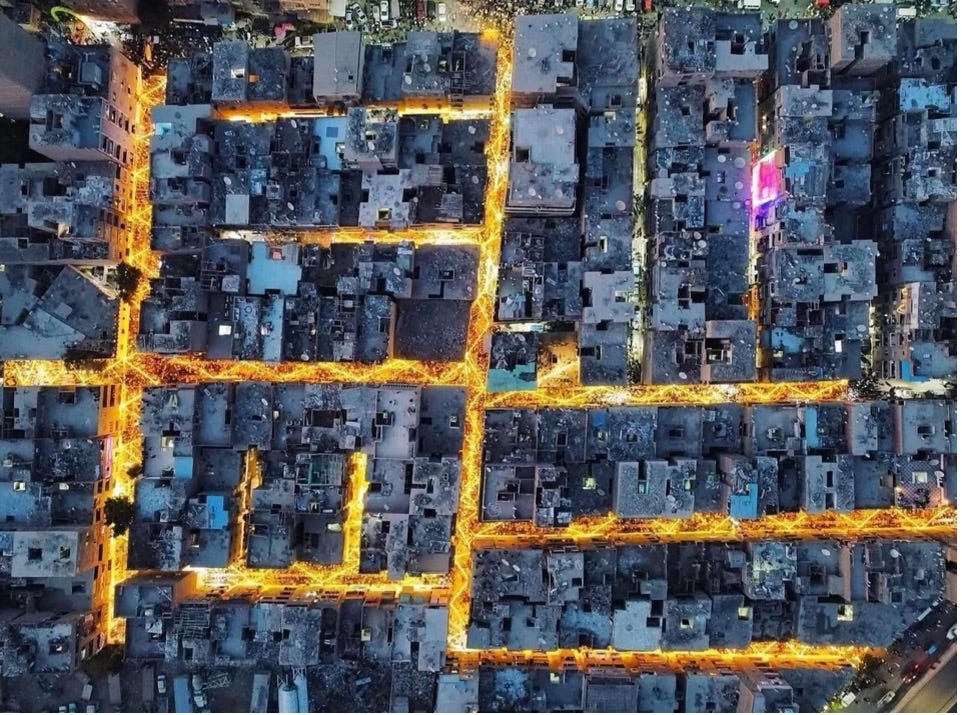
Iftar El-Matareya began when members from local families in Ezbet Hamada decided to organize an Iftar for some of their friends. When neighbors saw them, more people joined spontaneously. The following year, the organizers decided to invite the whole neighborhood, placing several tables along the street.
In just over a decade, what began as a small neighborhood gathering with a few tables and a handful of volunteers has grown rapidly each year, transforming into what is often called the world’s longest and most vibrant open-air Iftar table. It brings thousands of people together as if they are one big family, and at sunset, they break their fast together—first with dates and water, following a tradition practiced for centuries, then with meals that often include traditional Egyptian dishes such as rice, vegetables, meat or chicken, along with high-calorie sweets and desserts. Moments later, the streets come alive with conversations, music, laughter, and gratitude as children run holding lanterns.
According to different media reports and organizers, in recent years, Iftar El-Matareya features over 1,000 interconnected tables that extend along several narrow, decorated alleys and up to 15 lantern-lit, closed-off streets in the district—often stretching more than 1.5 kilometers. The number of attendees has increased over the past few years, from 10,000 to 25,000. In 2026, the 15th of Ramadan fell on March 5, and attendance approached 100,000, including neighborhood residents, volunteers, donors, and visitors from all over Egypt.
The scale of Iftar El-Matareya requires the entire neighborhood’s involvement. It is a classic example of a large-scale, coordinated community effort. Residents begin preparing weeks in advance. Volunteers organize logistics, coordinate food preparation, and arrange seating. Local businesses, philanthropists, and charities contribute ingredients, families cook large quantities of traditional dishes, and young volunteers decorate the streets with colorful banners and Ramadan lanterns known as fanous. Families arrive carrying dishes prepared at home, volunteers place dates and water at each seat, and the aroma of traditional Egyptian dishes fills the air. The streets, usually busy with the rhythm of everyday life, transform into a festive communal dining area.
Despite its growing fame, the heart of the gathering remains unchanged: it is not just a meal to break the fast; it is a powerful symbol of solidarity, generosity, and the enduring social spirit that defines the community in Egypt. It embodies the deepest values of the month, including hospitality and the idea that everyone should have food on the table, let alone that no one should eat alone, especially during Ramadan. Today, we talk about a world that should be more inclusive, where no one is left behind. The whole idea of Iftar El-Matareya and what makes the gathering extra special is its inclusiveness: people from different walks of life, rich and poor, young and old, locals and visitors—all sit side by side. Socioeconomic distinctions fade as people share the same table, the same meal, the same drink, and the same experience. It is a reminder that the heart of Ramadan lies in a timeless humanistic message: sharing, compassion, and the joy of community.
Iftar El-Matareya carries deeper symbolism and meaning. In a world often marked by social divisions and economic challenges, the gathering represents the power of collective generosity. It shows how communities can come together to create moments of unity and joy. The event reflects the enduring strength of neighborhood culture in Cairo. Despite the rapid pace of urban life in a city of more than twenty million people, local communities remain deeply connected.
In a city known for its rich history, cultural heritage, and vibrant traditions, Iftar El-Matareya stands out as a powerful model of grassroots hospitality that is embedded in Egyptian culture. One of the most remarkable aspects is that from the outset, it was never designed to be a large public spectacle. It demonstrates that traditions do not need grand institutions to flourish and serves as a reminder that the most meaningful traditions often arise from ordinary acts of kindness and require only people willing to contribute their time, energy, and goodwill.
In today’s challenging global landscape, hope, optimism, inclusion, and compassion are more than just comforting words. They are active forces that help communities face various crises—such as climate change, geopolitics, and increasing inequality. They are essential in keeping communities resilient during modern challenges. Community engagement and mutual support highlight how the world should function, where collaboration can create greater impact. They turn moments of difficulty into opportunities to rebuild societies that are more resilient, equitable, compassionate, and humane.
About the author: Sherif Kamel is a Professor of Management and Dean of the Onsi Sawiris School of Business at The American University in Cairo.
19 March 2026
Issue #63
رمضان في مصر حاجة تانية
والسر في التفاصيل
رمضان في مصر غير الدنيا
طعمه بطعم النيل