
The NileView
Cairo Welcomes PRME Global Forum and Responsible Management Education Week

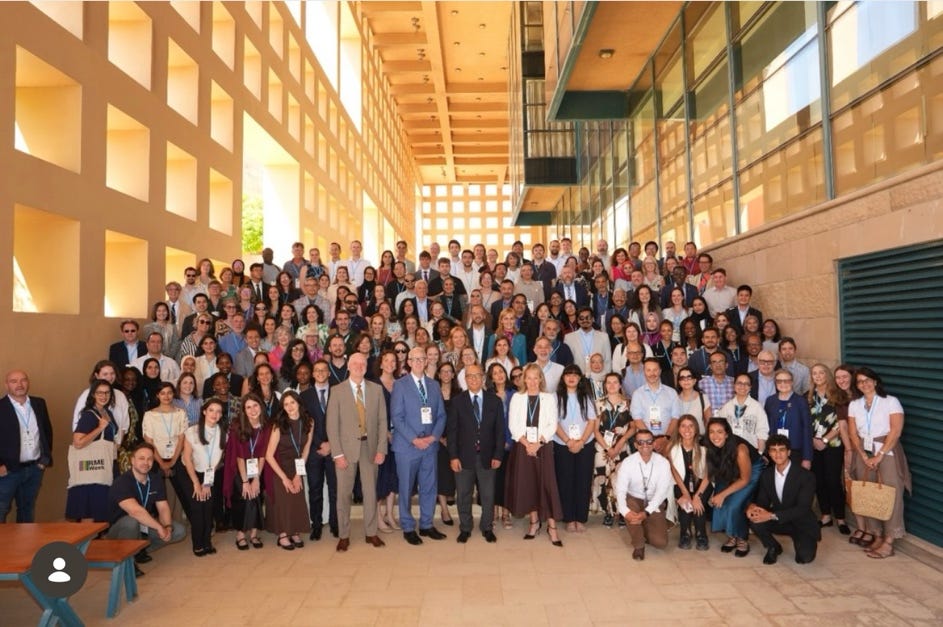
For the first time, the Principles for Responsible Management Education (PRME) Global Forum and the Responsible Management Education (RME) Week, themed “Counting on Collective Values,” were held outside the United States. The 2026 edition, hosted by the Onsi Sawiris School of Business at The American University in Cairo (AUC), brought together more than 400 scholars, educators, practitioners, and changemakers from 58 countries across all regions of the world, including 134 students representing prospective responsible future leaders. This milestone is far more than a change of venue; it is a statement about the importance of inclusivity, who gets to shape the future of business education, and whose voices matter in that conversation – clearly, everyone’s.
A Fitting Home in Cairo
There is natural symbolism in choosing Cairo to host this year’s event. Egypt has long served as a crossroads of civilizations and ideas, a place where knowledge has been preserved, exchanged, and transformed. AUC has embodied that spirit for 107 years, serving as a bridge between cultures and a platform for regional and global impact. The Onsi Sawiris School of Business, with roots dating to 1947, has built its identity on the conviction that Africa and the Global South make distinct and indispensable contributions to the world’s knowledge economy and societal prosperity. It was fitting for the PRME leadership to describe hosting the forum in Cairo not as a logistical decision but as a deliberate and welcome choice that reflects its values.
Onsi Sawiris School of Business’ engagement with PRME did not begin with this forum. It became a PRME signatory in February 2011 and, shortly thereafter, organized the 1st PRME MENA Regional Forum on Entrepreneurship, Sustainability, and Transparency. The school chose to organize this gathering at a difficult time for Egypt and the entire region. It was timely and relevant to discuss the importance of responsible management education and its impact on society. Over the past 15 years, the school has remained an active member of both the Africa and MENA PRME chapters, helped expand the network of regional signatories, and earned recognition as a PRME Champion. That sustained commitment set the stage for Cairo to be entrusted with this special hosting role, which we, as a school, are delighted to have and even more honored by the responsibility that comes with it. It also reinforces the school’s position as a credible convener of global dialogues on issues that matter to the world of business education and as a valuable contributor to societal development.
Global Unity, Local Impact
This year’s forum theme, Global Unity, Local Impact, perfectly reflects what our community needs. It captures the tension responsible management education must navigate. Global unity means recognizing that climate change, inequality, and the erosion of institutional trust do not respect national borders. Local impact means that responses to these challenges must be tailored, grounded, and accountable to the communities they serve. As Omid Aschari, former PRME Senior Advisor, reflected in a shared communication, “the future of responsible management education will not be defined by how well ideas travel from one center to the world, but by how deeply they are reinterpreted, embodied and acted upon in local realities. Global unity is not achieved by reducing difference. It is achieved when difference becomes a source of insight, responsibility and shared purpose.”
Moving the forum to Cairo and, next year, to Kuala Lumpur reflects a strategic decision to strengthen PRME’s global presence and relevance across diverse regions such as Africa and Asia rather than concentrating it in a single geographic hub. This shift matters because the challenges business leaders face today — from technological disruption to institutional distrust — are global in scale yet local in consequence, and cannot be solved by exporting a single leadership model. More importantly, it is a learning process for all, as we realize day after day that our similarities far outweigh our differences. Besides, the more we talk to each other, the more we learn, and the more we realize how much we do not know.
Why This Moment Matters
The forum convened at a genuinely consequential time. Across Africa and the Global South, a new generation of students and professionals is emerging, expecting a world designed with them in mind and confronting issues such as ethical leadership, equity, the climate transition, demographic shifts, and the transformation of global supply chains. Artificial intelligence adds urgency to this moment, reshaping industries and redefining skills while raising pressing questions about fairness, inclusion, and what it means to be human. How can all this be integrated into the curriculum and other business schools’ offerings so that students are equipped with the knowledge and understanding to become responsible, ethical, and principled leaders and to make a difference in society? This question, among others, surfaced throughout the RME Week during plenary sessions, panel discussions, and networking opportunities.
However, the primary question and point of discussion among the participants was not whether business schools should address these issues, but whether institutions are brave and rigorous enough to redesign themselves around them. This was a clear call for action and transformational change. In this framing, responsible management education is not a niche concern — it is the central challenge of preparing graduates who are technically capable and morally courageous and of building institutions that are both globally ranked and locally rooted.
Voices from the Global Community
The experience, energy, passion, commitment, and, above all, substance exchanged were evident in the wide range of sessions held throughout the week.
Sanda Ojiambo, CEO of the United Nations Global Compact, and David Steingard, Head of PRME, joined me at the opening plenary to discuss how business schools can serve as catalysts for responsible leadership by advancing research, embedding sustainability across curricula and in community development, and forging partnerships with business, industry, and other stakeholders to address real-world challenges and help prepare graduates to lead meaningful change.
Mahmoud Mohieldin, UN Special Envoy on Financing the 2030 Agenda for Sustainable Development, delivered a keynote address on advancing collective impact and the power and significance of emphasizing that global directions matter, but that it all starts with the local context. He also highlighted the importance of partnerships, alignment, and shared responsibility for achieving the Sustainable Development Goals.
A youth-centric panel on climate leadership across the Global South, featuring Ayman Ismail of UN Global Compact, alongside the World Bank’s Stephane Guimbert, Amit Jain of Nanyang Technological University’s Center for African Studies, and Commercial International Bank’s Dalia Abdel Kader, focused on equipping young people with green skills for inclusive economic transitions, addressed the importance of youth innovation through grassroots initiatives and student projects that can influence climate policy, and emphasized cross-sector collaboration and ensuring that marginalized voices from the Global South are heard in global negotiations.
Another session explored PRME’s Impactful Five (i5) framework in management education, sharing global experiences with implementing sustainability case writing, experiential learning, and responsible management education in practice, and reflecting on challenges, successes, and pedagogical innovations. These discussions demonstrated PRME’s broader push to move beyond conceptual sustainability content toward pedagogy that is creative and produces lasting impact on students and society.
Leaders from Business Schools 4 Climate Leadership (BS4CL) Africa and beyond, including deans, faculty, and representatives from Stellenbosch Business School, Lagos Business School, Gordon Institute of Business Science (GIBS), Strathmore Business School, ESCA School of Management, and Onsi Sawiris School of Business, emphasized during their 5th annual roundtable that meaningful climate action requires institutions to move beyond silos and that African Business Schools need to tell their stories about their realities and bring more partners from different walks of life to the table. The participants came together to explore how business schools can accelerate climate action by working collectively to educate responsible leaders, advance impactful research, and strengthen partnerships.
The RME Week welcomed the inaugural in-person PRME Student Summit. For the first time, students from across the Global South and other parts of the world gathered in Egypt to share their visions for responsible leadership, sustainability, and collective impact. The event featured an intergenerational dialogue on responsible leadership, with two days of policy discussions, workshops, and networking to turn student ideas into action.
A Platform for Collaboration, Not Competition
Perhaps the most consistent message to emerge from the week was that no single institution, sector, or region can solve today’s challenges alone. In that sense, collaboration is no longer optional; it is a shared responsibility. Business schools and academia in general, corporations, accreditation bodies, the UN Global Compact Network, and other stakeholders each have a role to play in shaping the future of responsible business education. This sentiment echoed throughout sessions on climate leadership, artificial intelligence, and future skills, reinforcing that students need more than technical knowledge; they need judgment, critical thinking, and the confidence to navigate uncertainty.
What This Means for Business Education
The significance of hosting this forum in Cairo extends well beyond ceremony. It signals a structural shift in how global institutions approach representation, relevance, and the sources of innovation in management education. For decades, the dominant models of business education largely flowed outward from a small set of geographic centers. Bringing the PRME Global Forum to Africa for the first time challenges that flow, inviting the world to learn from African and other institutions in emerging economies rather than simply exporting frameworks to them.
For the broader business education community, the Cairo forum offers a practical example of genuine global-local integration: sessions grounded in African realities, discussions linking climate action to youth employment, and student leaders from dozens of countries co-creating solutions rather than passively receiving them. This model is directly relevant to other emerging regions seeking a stronger voice in shaping global standards for management education.
Building Momentum for Society at Large
The implications of this gathering extend beyond university walls and into the societies these institutions serve. At its core, responsible management education prepares the people who will run companies, shape policy, and lead communities to weigh purpose alongside profit and treat sustainability and ethics as central rather than peripheral concerns. When business schools embed these principles in their curricula, case studies, and research agendas, the ripple effects reach work practices, corporate governance, environmental stewardship, and social equity across economies.
The forum’s emphasis on connecting education to labor market needs, particularly around green skills and youth employment in the Global South, speaks directly to the economic development challenges facing many emerging markets. Similarly, discussions on rethinking financial and accounting systems to better support the Sustainable Development Goals point to tangible pathways for aligning business practices with the broader social good.
The content-rich week was complemented and endorsed by a series of workshops and panel discussions on societal impact, held in the context of AACSB’s evolving global standards and EFMD’s Ethics, Responsibility and Sustainability (ERS) in practice. The week concluded with several panel discussions organized by RRBM and the African Academy of Management. A globally diverse lineup of leading scholars and representatives from universities and accrediting organizations exchanged ideas on advancing responsible research and its impact, emphasizing the value of collaboration, partnerships, and cultural diversity. I am grateful to them for their participation and contribution to this important conversation.
I firmly believe that progress deserves celebration, but there is always more work ahead. We never reach the finish line; there is always room for improvement, and we need to remain committed to learning. This balance of pride and humility ran throughout the forum’s ethos, treating the event not as a static achievement but as a living, ongoing commitment. The forum’s co-organizers — AACSB, EFMD Global, RRBM, and the Africa Academy of Management — joined PRME in supporting this edition, reflecting the cross-institutional partnership the week itself championed. As Andrew Karolyi, dean of the SC Johnson College of Business at Cornell University, noted during one of the sessions he moderated on challenging academic incentivization structures, “the institutions engaged in this year’s edition of the forum are a powerhouse capable of realizing the ambitions and objectives of responsible management education.”
Ultimately, the true measure of the 2026 RME week will not be the recommendations produced, but the shared commitments institutions carry forward into their classrooms, research agendas, and community partnerships.
As articulated during the opening reflections and throughout the week, the hope was not only to inspire participants but also to genuinely challenge them to determine what this global community is committed to doing differently moving forward. The discussions emphasized and reinforced the urgent need for business schools to prepare future leaders who can lead with purpose, integrity, and impact while embracing sustainability and innovation.
Thank you to all who joined and emphasized the importance of creating enabling environments for change, advancing the business case for sustainability, and rethinking systems to better support the Sustainable Development Goals.
Cairo’s hosting of the 2026 edition of PRME Global Forum and RME Week is an invitation — to universities, businesses, policymakers, and students alike — to continue building a more inclusive, collaborative, and purpose-driven future for business education and the societies it ultimately serves.
About the author: Sherif Kamel, Professor of Management and Dean of the Onsi Sawiris School of Business at The American University in Cairo.
4 July 2026
Issue #67