
The NileView
Dandara: One of the Jewels of Upper Egypt and A Gatekeeper of Civilization

Dandara (also known as Dendera) is more than just a village—it is a living open museum of Egyptian civilization, another jewel in Upper Egypt, where history, culture, community, and the Nile come together in beautiful harmony. Dandara is a village that refuses to be ordinary. If Egypt were a necklace, the Nile would be its golden chain, Dandara would be one of its brightest pearls. Located on the west bank of the Nile, about 70 kilometers north of Luxor, Dandara is home to one of the most impressive temple complexes in the world: the Temple of Hathor, goddess of love, music, and joy.
This is the third edition in a series of NileView publications focusing on Egypt, sharing a journey along the Nile and across the country. The series aims to highlight Egypt’s rich history and cultural heritage, promote its status as a top global tourism destination, and help unlock its full potential. The previous two editions covered the cities of Luxor and Alexandria. This edition returns to Upper Egypt to explore Dandara.
I have visited Upper Egypt over a dozen times, traveling to different cities and villages for leisure, work, and study. Over the years, I traveled there by plane and train, including several Nile Cruises from Luxor to Aswan–one of the best cruises globally. I went alone, with family, friends, and colleagues. My first visit was in 1981. My most recent trip was earlier this month, when I visited Dandara. It was not my first time there, but each visit offers a new perspective and further deepens my deep appreciation and admiration for Egypt’s history and cultural heritage. Dandara is not just about ancient temples, stones, and hieroglyphs. It is about continuity and longevity: a place where the Nile whispers stories that date back all the way to the time of the pharaohs. It is about the prospects that could make Dandara a centerpiece of Egypt’s cultural renaissance.
Dandara’s history stretches back over 4,500 years, with evidence of settlement and religious activity from the Old Kingdom through the Middle and New Kingdoms, as well as the Ptolemaic, Greek, Roman, and Christian periods. This makes it one of Egypt’s longest continuously used sacred landscapes. Dandara is home to the Temple of Hathor, built on the ancient site of Tentyra, the capital of the 6th province of Upper Egypt, covering more than 84,000 square meters and enclosed by a large, dried mud-brick wall. Regarding royal connections, Pharaohs from Pepi I to Cleopatra VII left their mark on the temple. Cleopatra is depicted on the temple walls alongside her son Caesarion, like an ancient family portrait, proving that Dandara was a stage for both Egyptian and Roman drama.
Although Dandara is famous for the Temple of Hathor, it is important to note that it is not just a single-temple site. It is more of a temple complex that also includes a Birth House dedicated to the divine birth of Hathor and Horus’s child; a Sanatorium used for healing rituals where visitors could bathe or sleep to receive divine cures; a Sacred Lake utilized by priests for purification ceremonies; a Basilica built during the Byzantine era for worshippers; and a Roman Kiosk constructed during the Roman period for ceremonies and processions. The complex shows how the village itself has evolved over thousands of years, reflecting a strong sense of community. In short, Dandara is like a flavorful feast of history, with Old Kingdom appetizers, Ptolemaic main courses, and Roman desserts.
The Temple of Hathor is an example of traditional Pharaonic architecture decorated by a hypostyle hall leading to a sanctuary and supported by eighteen Hathor-headed columns. The temple was built and rebuilt across centuries. It was initially built during the Ptolemaic period with major alterations and expansions under Greek and Roman rule. It is one of the best-preserved temples in Egypt, standing tall, with crisp carvings and vibrant colors. Its ceilings and walls are famously decorated with astronomical scenes, including the celebrated Dendera Zodiac, which shows how Egyptians mapped the sky long before telescopes–maybe they were stargazers too, or perhaps the world’s first horoscope enthusiasts. Millennia ago, Egyptians pioneered in many fields, including construction, medicine, mathematics, irrigation, and astronomy.
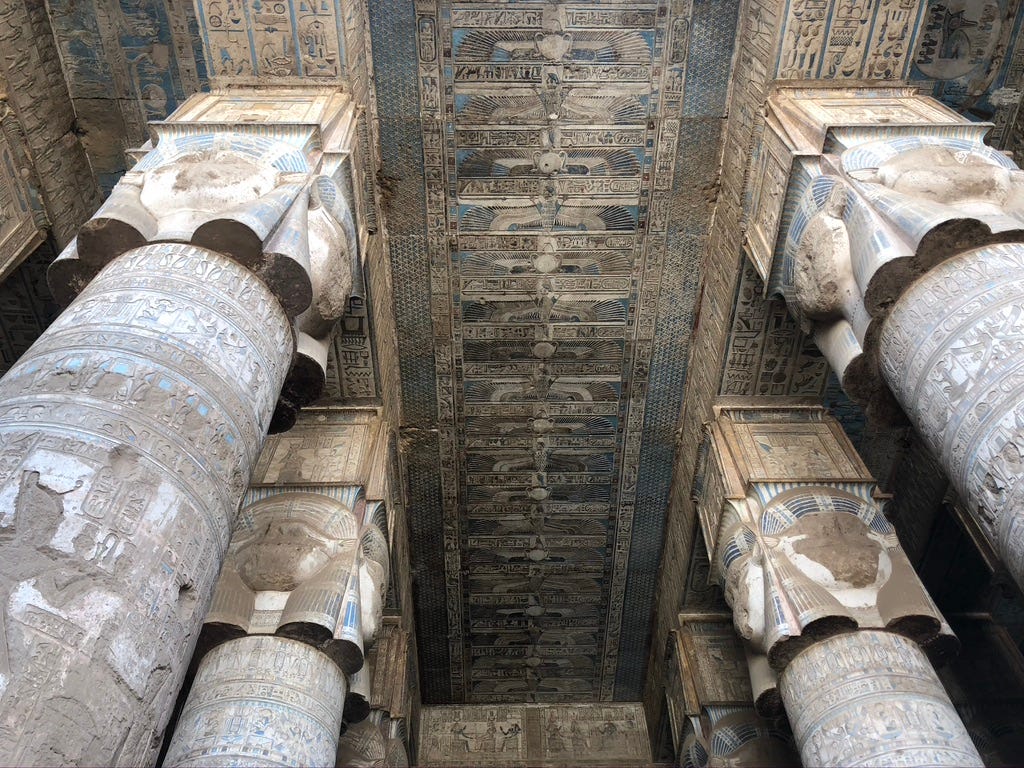
The Temple of Hathor that visitors see today is largely a Ptolemaic creation, completed and enhanced under Greek rulers who adopted local religious traditions. During the Roman period, the temple complex continued to operate and receive imperial patronage, and additional decorations reaffirmed local cultic rituals and expressed the rulers’ claim to legitimate authority through visible piety. Many reliefs and inscriptions show a fusion of Hellenistic and native motifs, testifying to cultural interaction and demonstrating a sense of continuity of traditions that preserved ancient practices. In later periods, the temple’s reuse for Christian worship illustrates a pattern that was common across Egypt, in which sacred spaces were reimagined to accommodate new religious beliefs while retaining echoes of their earlier roles. The history of Dandara is exemplary for understanding religious resilience, adaptation, and cultural memory.
Dandara offers more than the temple complex. For those interested in local cultures, Dandara offers opportunities beyond sightseeing, including festivals, concerts, and cultural events. The village and its surrounding neighborhood are home to a local community renowned for its authentic Egyptian craftsmanship. Imagine a modern music festival in the Temple of Hathor—after all, it was dedicated to music and joy. Tourism in Dandara is about experiencing Egypt’s authentic and vintage soul.
Since ancient times, Egyptians have always been attached to the land, and one of the primary reasons has been the Nile and the ecosystem it helped create. The Nile has always been the lifeline of Egyptian civilization. It serves as Egypt’s eternal stage, and as the Greek historian Herodotus said, Egypt is the gift of the Nile. Most Egyptians have consistently lived along the banks of the Nile Valley, where the land is fertile. The soil is rich and suitable for growing crops, which is vital for Egypt, a country that has traditionally relied on agriculture.
Furthermore, the Nile played a major role in Dandara’s history. Over thousands of years, the Nile provided water, transport, and spiritual meaning, and continues to do so. The Nile enhanced Dandara’s economic role in trade and agriculture. From a spiritual perspective, Egyptians believed the Nile was a divine gift, and temples dedicated to Hathor were built near it to honor the gods.
I strongly believe that, with its unique blend of historical and cultural heritage, the Temple of Hathor should be considered a UNESCO World Heritage site, attracting even more international attention and rightly garnering greater global recognition. For millennia, Dandara has been one of the Jewels of Upper Egypt and a Gatekeeper of Civilization.
Today, with the new road network, tourism in Dandara is surging. Visitors from Luxor frequently take day trips to the village, admiring its accessibility and preservation. Naturally, Dandara is reachable from the Nile, making it an ideal stop for those on a Nile cruise. With further strategic investments in developing visitor centers, interactive museums, and digital guides, Dandara could become a model of modern heritage tourism; its future could be as bright as its past.
Egypt’s cultural heritage is immensely diverse, with many sites depicted along the Nile from the Mediterranean Sea in the north to the borders with Sudan, and spread across the country. As Egypt continues to invest in cultural tourism, Dandara is poised to join Luxor and Aswan as a must-see destination in Upper Egypt. Why not? It has the history, temples, culture, and spirit of one of the world’s oldest civilizations and could become one of Egypt’s most attractive historical and cultural destinations.
Dandara remains an immensely attractive destination, thanks to its unique appeal. It does not offer the grandeur of Luxor, which dazzles with its Luxor and Karnak Temples among other attractions; however, Dandara offers a more intimate experience. Visitors often comment that the Temple of Hathor feels like stepping into a time capsule for its architectural completeness, richness of its intellectual and ritual carvings, and what it reveals about cultural encounter and institutional life in Egypt from the pharaonic through the Roman periods. Its layered history—structural, artistic, religious, and social—makes the temple not only a jewel of antiquity but also a vital record for anyone seeking to understand how sacred spaces shape, and are shaped by, the communities that sustain them. The prospects for Dandara are immense.
About the author: Sherif Kamel is a Professor of Management and Dean of the Onsi Sawiris School of Business at The American University in Cairo.
30 November 2025
Issue #58