
The NileView
Can Business Schools Help Shape Leaders in MENA?

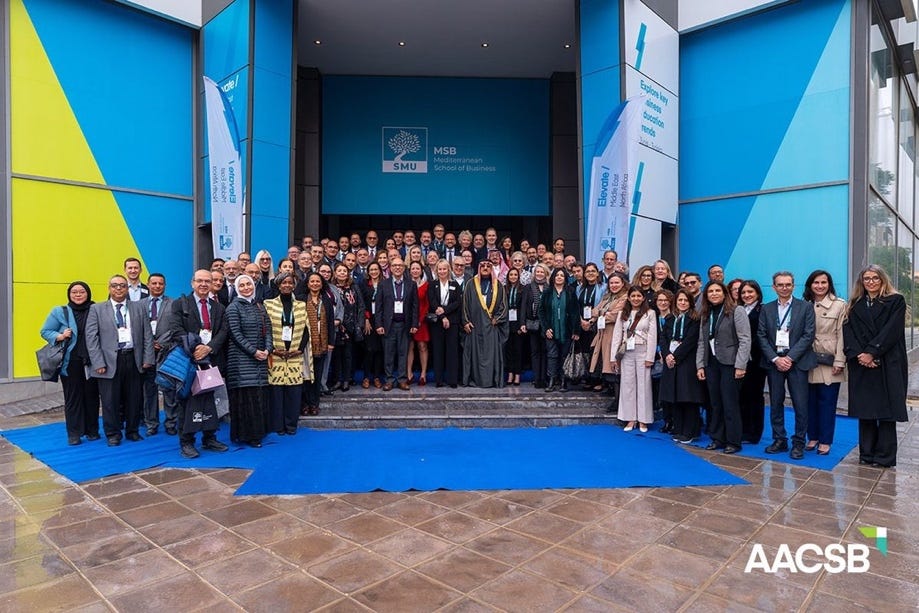
Amid a heavy storm that lasted for a couple of days, arguably the strongest in Tunis since 1950, with the most intense winds, rainfall, and flooding, the current state and future prospects of business education in the Middle East and North Africa (MENA) region were discussed in a vibrant, well-organized, and deeply engaging setting during AACSB’s Elevate MENA conference, held on January 20-21 at the Mediterranean School of Business (MSB) of South Mediterranean University in Tunis.
Elevate brought together business education leaders, including deans and associate deans, faculty members, innovators, entrepreneurs, and strategic thinkers to share best practices from business schools in the region and beyond, given the constant disruptions from digital transformation, economic shifts, climate change, and evolving demographics, among others. The conference convened at a time when business education is being asked to rethink not only what it teaches and how it teaches, but also why it exists and for whom, and how to value and measure its impact on society.
Against Tunisia’s rich historical and cultural backdrop—a bridge between continents, civilizations, and cultures—the conference offered both reflection and resolve: reflection on the challenges facing business schools globally and resolve to act with clarity and purpose. The overarching question was: can business schools help shape leaders in MENA while balancing global developments, adapting to the local context, and remaining impactful through a purpose-driven value proposition that makes a real difference in society? The answer is yes, but how? What should business schools do?
In the region’s vibrant yet challenging socioeconomic and political landscape, business schools are emerging as pivotal institutions, shaping the next generation of leaders equipped to navigate the complexities of a rapidly transforming regional marketplace. As entrepreneurs rise to meet the challenges of innovation and sustainability, these schools are redefining curricula, fostering valuable connections, and igniting a passion for excellence among aspiring business professionals.
The conference topics included highlights on AACSB’s evolving Global Standards for Business Education and Global Research Impact Framework; the debate over whether degrees or skills are more important for the future of learning and the future of work; what truly shapes future-proof talent; and how to help build a competitive edge in the future. What needs to be done regarding curriculum innovation? How can SDGs and ESGs be seamlessly integrated into the learning experience? What should be done about students’ mobility? In addition to the challenges of credit transfer systems, joint research, and student exchanges, the importance of going beyond the classroom and engaging students in projects with business and industry was emphasized.
What stood out for me, besides the opportunity to reconnect with colleagues and make new friends, to exchange experiences and learn from them, the quality of the discussions, and the valuable contributions they made, was the usual collegiality, energy, momentum, and sense of community. Besides, the two-day conference was candid, constructive, and forward-looking. The conversations moved fluidly among strategic aspirations, daily challenges, prospects, and the navigation of global frameworks, while remaining focused on the regional context and realities.
The conference reflected the opportunities that business schools could leverage as key stakeholders in society. The issues addressed throughout the conference reflected the complex realities of contemporary business education, both globally and within the MENA region. I should also note that it was, as always, a valuable opportunity to engage in rich discussions about the future of learning, what it entails, and whether business schools can effectively prepare the next generation of leaders to make an impact on society. In a world searching for principled, responsible leaders, the role of business schools has never been more consequential.
Building One Community and Minimizing Silos
From the get-go, the participants emphasized the importance of collaboration. Speakers and panelists were not positioned as distant experts delivering static prescriptions, but as engaged partners in dialogue. Sessions were characterized by thoughtful questions, insightful and thought-provoking discussions, spirited debate, and a willingness to confront uncomfortable truths—an essential ingredient for progress. There is not much choice there!
Several deans spoke candidly about enrollment volatility, faculty workload pressures, funding constraints, visa issues, and, at times, the differences between accreditation standards and local relevance. Faculty shared experiences from classrooms undergoing rapid transformation due to artificial intelligence and how to rethink the human advantage, hybrid delivery models, assurance of learning, and changing student expectations. Accreditation leaders contextualized AACSB standards not as compliance mechanisms, but as strategic tools that are principle-based and support mission-driven innovation–a dynamic platform for continuous improvement and progress.
What emerged was a sense of shared ownership. Challenges were not framed as individual institutional struggles but as collective responsibilities for the business education community. This spirit of collegiality and mutual respect underscored the conference’s greatest strength: its ability to foster trust.
Adaptability and Relevance in a Transformative Environment
A recurring theme was the question of relevance. How can business schools remain meaningful in a world where knowledge is abundant, skills evolve rapidly, and employers increasingly value adaptability, ethics, and purpose alongside discipline-based competence? Speakers emphasized that relevance is no longer achieved through curriculum updates alone. It requires deeper engagement with diverse stakeholders, ongoing dialogue with alumni, and co-creation of work-related learning experiences and models with business and industry. The conference highlighted the importance of live consulting projects, in-house incubators, and interdisciplinary programs that connect business to a wide range of topics, including global affairs, changing market dynamics, innovative technologies, public policy, and sustainability.
Faculty are in the Driving Seat
The discussions emphasized that faculty are the drivers of change and, in a world of continuous disruption and transformation, highlighted the importance of regular faculty development, the availability of resources to set clear research expectations, investment in pedagogical innovation, and the evolving definition of scholarly impact. Rather than framing the discussion as a binary choice between teaching and research, participants explored more nuanced models of impact-oriented scholarship—research that informs policy, advances practice, and addresses societal challenges while maintaining academic rigor and integrating executive education and community development projects—these should not be silos.
Focus on Ethics, Responsibility, and Societal Impact
Perhaps the most powerful conversations, whether during the panel discussions or the networking sessions, centered on the role of business schools in shaping ethical leaders. In a region marked by demographic dynamism, economic transformation, and social aspiration, participants emphasized that business education must be anchored in responsibility. Sessions explored how schools are embedding ethics, sustainability, and social impact throughout the curriculum—not as standalone courses, but as integrated perspectives that shape decision-making across disciplines. The alignment between AACSB principles, the UN Sustainable Development Goals, and regional priorities resonated strongly, reinforcing the idea that business schools are not neutral actors but moral institutions with societal obligations.
Context Matters
One of the most compelling aspects of the conference was its explicit recognition that context matters. While global standards provide coherence and comparability, regional realities shape how those standards are interpreted and implemented. Participants discussed issues unique to the MENA region, including youth unemployment; entrepreneurship as a necessity rather than a choice; the role in family businesses; public-sector dominance in some economies; and the growing role of women in leadership. Rather than viewing these as constraints, speakers framed them as opportunities for distinctive educational models that reflect local needs while remaining globally connected.
Conversations Sparking Insights and Actions
The panels were among the conference’s most impactful moments. Carefully curated to include deans, faculty, industry representatives, entrepreneurs, and AACSB leaders, they moved beyond surface-level discussion to explore implementation challenges and real-world trade-offs.
Audience participation was robust and thoughtful. Questions were probing, often challenging assumptions and inviting speakers to reflect on lessons learned and failures rather than idealized success stories. This openness created a learning environment grounded in authenticity—a reminder that transformation is iterative, imperfect, and deeply human; we all make mistakes. There is always room for improvement, which means constantly raising the bar and elevating aspirations. Equally important were the informal interactions: conversations over coffee, shared meals, and spontaneous hallway exchanges–maximized due to the non-stop rain outside. These moments often proved as valuable as formal sessions, laying the groundwork for future collaborations, benchmarking partnerships, and shared initiatives across institutions.
The conversations reaffirmed that business education in the region, as in other parts of the world, is at a pivotal moment—one that demands courage, creativity, and collaboration. The conference underscored that accreditation is not an endpoint, but a journey of continuous improvement. It also affirmed that innovation, including artificial intelligence, does not require abandoning rigor. Global alignment and local relevance are not competing objectives but rather complementary. Most importantly, it reminded participants that business schools are stewards of future leaders who will navigate uncertainty, build organizations, create jobs, and shape societies. This responsibility cannot be deferred or diluted.
Looking Forward: An Invitation to Collaborate and Innovate
As the conference concluded, the prevailing sentiment was a call to innovate further, collaborate more, and act more quickly. The discussions evolved into commitments to faculty development, curriculum renewal, stakeholder engagement, and purposeful leadership. In addition to the need to reimagine business education with confidence, grounded in values and informed by evidence, there was an invitation to collaborate more within the region and beyond, across institutions and disciplines. There was also an invitation to lead—not by imitation, but by innovation rooted in context and conviction. That future, while complex and demanding, is filled with possibilities.
The thread running through so many sessions was skills—but not in a strictly technical sense. Yes, technical capability matters. But human capabilities are the differentiator: critical thinking, cognitive agility, creativity, empathy, and judgment. Human advantage is, and will remain, the key factor. If artificial intelligence augments, then we need to be even more intentional about developing what makes us distinctively human. The focus should be on building capacity for faculty, staff, and students while keeping an eye on outcomes, not just outputs.
Overall, the exchange of ideas and experiences with peers reinforced the community’s strength and shared commitment to excellence and continuous improvement, and highlighted the power of collective intelligence in advancing business education. The conference was a valuable addition to the evolution of the business education landscape in the region, calling for greater agility, relevance, collaboration, adaptation, and impact-driven action. It was a wonderful opportunity in which an open, collaborative space brought together business school leaders, entrepreneurs, and other stakeholders to exchange ideas, strengthen collaboration, and reaffirm their personal commitment and that of their schools to help transform a region blessed with ample opportunities, most of which remain untapped.
Thank you, Leila Triki, Dean, Mediterranean School of Business, for a warm welcome and hospitality, and a wonderful organization led by your team and coordinated by your students–Tunisia’s future leaders.
About the author: Sherif Kamel is a Professor of Management and Dean of the Onsi Sawiris School of Business at The American University in Cairo.
15 February 2026
Issue #61